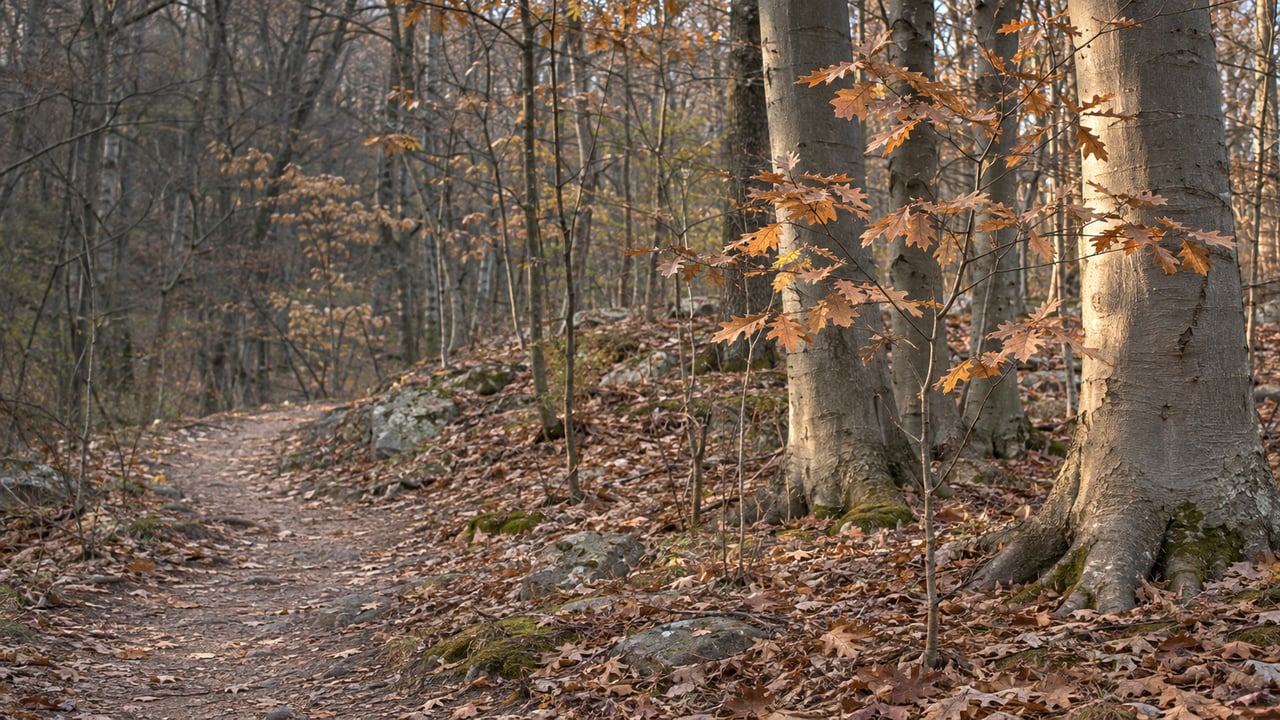
This fall the New Jersey Department of Environmental Protection awarded the Tenafly Nature Center Association $566,290 to restore 24 acres of forest at the preserve off Hudson Avenue. The plan has three parts: targeted beech leaf disease treatment, invasive species removal, and what the state calls "a large-scale native tree planting." Along with treating some trees, the money pays to shape what grows where the beeches decline.
The center's executive director, Debora Davidson, gave the reasoning in NJDEP's September 22 announcement:
"This funding allows us to get ahead of a disease that would otherwise reshape our forest for a generation. By replacing declining beech stands with a diverse, climate-resilient mix of native species, we're not just responding to a threat, we're strengthening the forest's ability to store carbon and support wildlife for decades to come."
Fifteen Acres of Beech, Twenty-Four Acres of Work
Two numbers frame the project. Last October, TNC reported that it had finished an inventory of its beech trees and found they covered roughly 15 acres of the preserve. It said mapping where those trees stand was the first step toward "planning for replacements to maintain a strong and diverse canopy."
The state-funded restoration covers 24 acres. That is a bigger area than the beech stands alone, which fits the grant's description. The work includes removing invasive plants and planting new native trees as well as treating beeches, so it reaches into forest beyond the mapped stands. The project runs three years.
Tenafly wasn't the only beech story in the state's list of awards. Passaic County received $1,477,471 to restore 49 acres in West Milford Township, a site the state described as hit by invasive species, soil degradation, "extensive beech tree mortality" and wildfire. Beech loss is a forestry problem across northern New Jersey. Tenafly's grant is one of the ways the state is paying to respond.
A Disease Measured in Years
Beech leaf disease is caused by an invasive microscopic nematode, according to Rutgers Cooperative Extension. It attacks beech leaves and buds and can lead to leaf distortion, branch dieback and death of the tree. Rutgers puts the time from infection to death at two to 10 years, depending on the size of the tree.
Tenafly Nature Center uses blunter language. The October 2025 update described "a devastating 100% mortality rate within just a few years." The center's homepage now promotes its fall program under the headline "Losing 99% of our Beech Trees!" and asks "What's Next for Our Forest?" Even at the slow end of Rutgers' range, the woods will look different within a decade.
The time frame matters because of how a forest refills a gap. Rutgers' guidance for landowners facing forest loss, when treatment isn't an option, is to plant native "cohort" trees underneath the declining canopy ahead of time and to fence out deer. Deer pressure is already part of the story at TNC. The center's October 2025 update called its "ever-present white-tailed deer" a reminder of "the challenges of balancing wildlife populations with healthy forests." Rutgers' advice rests on getting native trees growing before the canopy opens, so the gaps left by dead trees don't go to whatever survives the deer and the invasive plants.
TNC has also looked into treatment. The center hosted a beech treatment workshop with Rainbow Eco-Science that drew more than a dozen professionals. The state's award describes the treatment as "targeted," and lists it alongside invasive removal and native planting as one part of the project.
What Went Into the Ground Along the White Trail
TNC was planting native trees before the state money arrived. In its October 2025 fall conservation update, the center said 400 native trees would be planted around the front entrance and along the White Trail. The species were red oak, white oak, shadbush and sweet bay magnolia.
The center explained the choices by what the trees support. "Oaks alone support hundreds of species of insects and caterpillars," it wrote, "which in turn provide food for countless birds and mammals." Davidson's "diverse, climate-resilient mix of native species" describes the goal for the grant's replacement of declining beech stands.
A separate TNC project shows the same approach at a smaller scale. Volunteers in the center's Forest Defenders program removed invasive plants along the White and Bischoff trails and planted 100 mid-story native trees off the White Trail. TNC lists Alex Braunstein as its Land & Facilities Manager. In last fall's update, the stewardship team named its two main targets. Japanese stilt grass and mile-a-minute vine, it said, "smother native plants and prevent healthy forests from regenerating."
Invasive removal and native planting are two of the three jobs the 24-acre grant now pays for, on a much larger scale.
TNC no longer hands out paper trail maps on site. Visitors use the center's interactive digital trail map, which it introduced in the same October 2025 update.
The Water Is Being Rebuilt Too
The forest isn't the only part of the preserve being rebuilt. Pfister's Pond has its own restoration, funded by a Green Acres grant from NJDEP and the Garden State Preservation Trust, with matching money from the Borough of Tenafly. TNC says that project covers shoreline repair, biodiversity restoration and reconstruction of the accessible main trail. The first phase, hydro-raking, was finished in 2021. In its October 2025 update, TNC said the next phase was starting that fall, aimed at better water quality, healthier aquatic habitat and a more resilient pond.
Put the two projects together and the main loop through the preserve, from the pond through the beech stands to the White Trail, is being rebuilt on two state grants at about the same time.
Where Residents Fit In
The forest grant includes volunteer work, and the Tenafly Today listing for TNC's free Nov. 11 Zoom session named volunteer opportunities as one of its topics, along with tree treatment and invasive-species control. Mayor Mark Zinna promoted that session in his Nov. 6 Mayor's Message. He described it as a look at how the disease is affecting local forests and how "a $566,000 state grant will support the restoration of 24 acres at Tenafly Nature Center."
Forest Defenders is the main way to help with the work itself. TNC describes the program as hands-on removal of invasive plants and other environmental threats, with sign-up through Bergen Volunteers. The next session is Sunday, Nov. 22, from 10 a.m. to noon at the nature center, 313 Hudson Avenue. According to the event listing, volunteers learn to identify and safely remove invasive plants alongside an expert land manager. Adults, teens and families are welcome, and children under 15 need a guardian.
Here is the rest of TNC's seasonal calendar through early December:
- Sunday, Nov. 15: Heal and Hike
- Tuesday, Nov. 17: Creative Camouflage with TSC
- Saturday, Nov. 21: Camp Open House and Nature Story Time
- Sunday, Nov. 22: Camp Open House and Forest Defenders
- Thursday, Nov. 26: Thanksgiving Day, TNC facilities closed
- Saturday, Dec. 5: Crafty Critters
TNC is also promoting "Celebrate the Longest Night!", a winter solstice night hike that ends with a campfire and s'mores.
The mayor's message lists more of the town's November calendar. The Senior Center holds its second annual Luminary Fundraiser on Thursday, Nov. 12, at 6 p.m. Luminaries are sold in honor or in memory of someone, and proceeds support cancer and Alzheimer's research. Tenafly print and etching artist Ellen Nathan Singer's exhibition, Woodcuts and Etchings, is on view at 55 Magnolia Avenue through Nov. 30, weekdays from 9 a.m. to noon and 1 to 3 p.m.
The grant's three-year restoration covers 24 acres of the preserve, and the next Forest Defenders morning is Sunday, Nov. 22, from 10 a.m. to noon at 313 Hudson Avenue.
At Ten Hoeve Advisory, we follow the local projects that shape the places our clients live, and a three-year rebuild of a town's main nature preserve is one of them. If you own in Tenafly and want to talk about how changes in your town, from the trails to the pond, fit into your plans, get in touch.